


Abstract: In order to solve the recycling problem of copper waste enamelled wire, after recent years of exploration and experience accumulation, our company has successfully developed the key technology and equipment for continuous pyrolysis recovery of copper enamelled wire together with Anhui Chujiang Technology New Material Co., LTD and other user units. The highest temperature of the equipment can reach 900℃, and continuous operation can be achieved. The copper recovery rate in the enamelled wire is 99.5%. The recovery rate of waste heat reached more than 85%. The annual recycling output of copper of this set has reached 20,000 tons, which makes an important contribution to the recycling and environmental protection of copper resource in our country.
Key words: copper enamelled wire; Continuous pyrolysis; Technology and equipment
Copper enamelled wire (hereinafter referred to as enamelled wire) is the key material for the manufacture of electromagnetic windings of motors, electrical appliances and telecommunication instruments. The copper raw material used is of high purity and is the main source of miscellany copper recovery. In 2010, the output of our country's copper lacquer wire reaches 1.24 million tons, the dosage of lacquer wire is close to 200 thousand tons, become the world first big country of lacquer wire manufacturing. By 2017, the output of waste enamelled wire was about 2.6 million tons. Due to the shortage of primary copper resources in our country, as the contradiction between the demand of copper products and the shortage of copper resources is increasingly prominent, recycled copper has been paid more and more attention and has become an important supplement in the supply of copper raw material.
There are many ways to remove lacquer for enameled wire, the earliest is artificial scraping, mechanical scraping and the use of paint remover. Manual scraping has some problems such as slow paint removal speed and poor paint removal effect. Mechanical scraping is easy to break the enamelled wire, resulting in serious copper loss. Besides, further separation and treatment are needed after scraping, and the purity of recovered copper is not high. There are some problems such as long time of paint removal, unsatisfactory effect, secondary pollution, slow speed of paint removal, low purity of recovered copper and limited kinds of paint remover, so it is difficult to realize large-scale application. Different components of enamelled wire paint started pyrolysis aging at 100℃, and finished pyrolysis at 600℃~800℃, the weight loss rate reached more than 90%. Therefore, pyrolytic enamelled wire paint is an effective method to recover enamelled wire. At the beginning, this method is to incinerate enamelled wire and realize mass production. However, the lack of effective protection measures in the process of incineration, serious heat loss, resulting in low efficiency, high cost, a large number of oil and gas, soot, especially dioxins and other pollutants directly discharged, pollution of the environment, and due to the participation of air, copper oxidation burn serious. Compared with centralized incineration, indirect pyrolysis is more efficient to treat enamelled wire and can effectively control the generation of dioxins, soot and other pollutants. However, indirect pyrolysis process of enamelled wire requires one rising and cooling process for each batch of materials, which has the problems of long cycle, high energy consumption and high labor intensity.
In view of this situation, through years of scientific and technological research, together with Anhui Chujiang Technology New Material Co., LTD and other user units, successfully developed complete sets of technology and key equipment for continuous pyrolytic recovery of enamelled wire, so as to realize the reuse of copper resources and efficient and environmental delacquering of enamelled wire.
1. Key technologies of enamelled wire continuous pyrolysis equipment
1.1 Continuous anaerobic pyrolysis technology
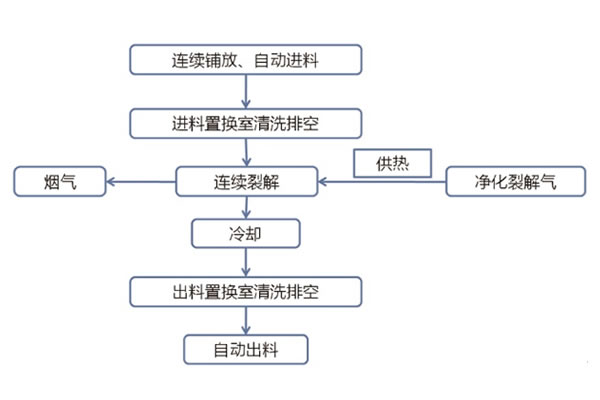
The continuous pyrolysis equipment of enamelled wire adopts the emptying and sealing method to recover the continuous pyrolysis of waste enamelled wire in anaerobic environment. The material enters the replacement room through the automatic feeding device, and the air outside is emptied and cleaned. After the replacement, the material enters the pyrolysis furnace for continuous pyrolysis. After the pyrolysis is completed, the pyrolysis gas enters the purification system for purification. Figure 1 shows the pyrolysis furnace treatment process.
FIG.1 Pyrolysis furnace treatment process
1.1 Pyrolysis tail gas cleaning technology
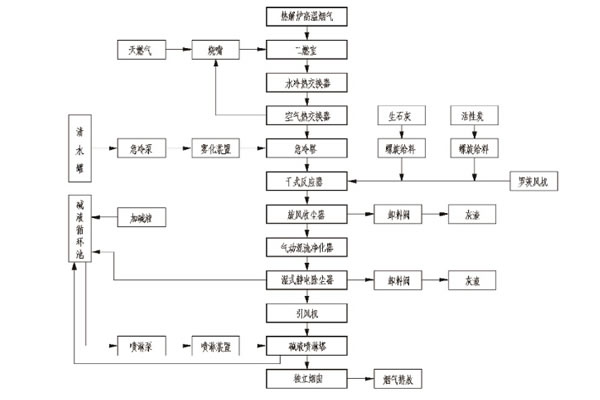
The continuous pyrolysis equipment of enamelled wire is based on the tail gas treatment process shown in Figure 2. The tail gas generated in the process of pyrolysis is discharged after a series of treatments such as continuous collection and secondary combustion. To achieve a reasonable and efficient clean treatment of pollutants such as volatile organic compounds (VOCs), fly ash, dust, heavy metals and acid gases in exhaust gas. The dioxins in the tail gas were completely decomposed and the secondary generation was inhibited by the treatment process of rapid full combustion and quench cooling.
FIG. 2 Pyrolysis tail gas treatment process
1.1 Waste heat recovery and reuse technology
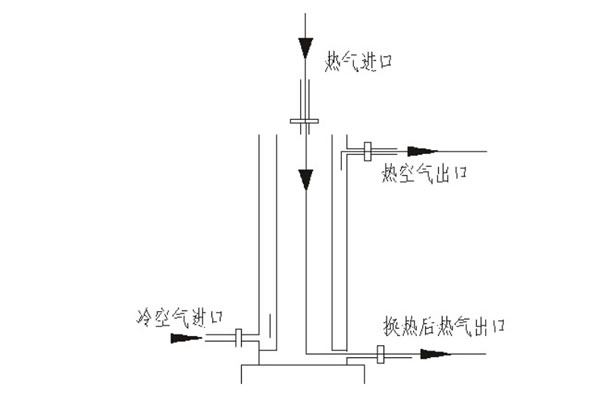
The enamelled wire continuous pyrolysis equipment adopts waste heat recovery and reuse technology. Figure 3 shows the schematic diagram of air cooling heat transfer of waste heat recovery technology. As shown in the figure, after secondary high temperature combustion in the tail gas treatment system, the high temperature tail gas is exchanged through the air cooled heat exchanger. Meanwhile, the outlet of the pyrolysis tail gas is set near the raw material feed section of waste enamelled wire. The pyrolysis tail gas preheats the raw material of waste enamelled wire into the furnace in the feed section and then discharged. Through the above methods to achieve the recovery and reuse of tail gas heat energy, energy conservation and emission reduction, reduce equipment energy consumption, waste heat recovery and utilization rate of more than 85%。
FIG. 3 Schematic diagram of air-cooled heat transfer of waste heat recovery technology
1.1 Intelligent automatic process control technology
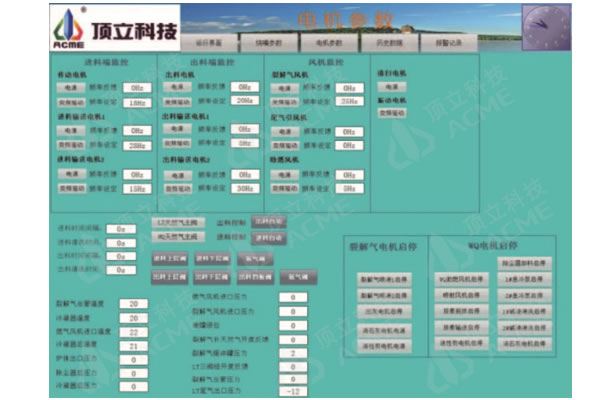
The enamected-wire continuous pyrolysis equipment carries out continuous feed-pyrolyzation-cooling-discharge processes under a stable pyrolysis temperature and cooling environment. The production line adopts a visual intelligent monitoring system (as shown in Figure 4) to realize continuous production and overcome the problems of long production cycle, high energy consumption and high labor intensity existing in traditional batch pyrolysis production. The operation of the entire production line equipment is controlled by computer integrated automation, and monitored by visual intelligent system to improve the efficiency of production operation.
Figure 4 Visual intelligent monitoring system
2. Enamelled wire continuous low temperature pyrolysis equipment and system
2.1 Equipment Composition
Enamel-wired continuous pyrolysis equipment consists of conveyor belt, replacement structure, pyrolysis furnace, secondary combustion chamber, quench tower, dry reactor, bag dust collector, electrostatic dust collector, induced draft fan, electric control device, etc.
2.2 System
2.2.1 Charging and feeding system
The charging and feeding system consists of a charging conveying mechanism and a replacement structure.
The material enters the pyrolytic furnace by the conveyor belt through the displacement structure. After the material has been emptied several times through the displacement structure, ensure that the air brought by enamelled wire raw materials is removed from the displacement room before the material enters the heating section.
2.2.2 Continuous anaerobic pyrolysis system
Continuous anaerobic pyrolysis structure is adopted, and the shell is welded from steel plates and profiles.
The lining is made of high quality refractory insulation brick, aluminum silicate fiberboard and aluminum silicate folding block.
After the furnace body rises to the rated temperature, the raw material of enamelled wire is sent to the transport track through the lifting device, into the replacement chamber filled with protective gas N2, and then into the furnace, the enamelled wire is continuously pyrolyzed in the protective atmosphere, and then into the cooling section, so that the copper of the enamelled wire is reduced to 80℃ and discharged. The protective gas in and out of the material is replaced with air to isolate the air. Meanwhile, the pyrolysis and cooling processes are run in a protective atmosphere to ensure an oxygen-free environment.
2.2.3 Cooling treatment system
The cooling section is composed of multiple sections with independent water inlet, drain, sewage outlet and water temperature gauge. The cooling water flow of each section can be adjusted independently through the valve. The flow direction of the cooling water is opposite to that of the conveyor belt, and it flows S-shaped under the action of the baffle. The water temperature meter can detect the water temperature of the drain.
2.2.4 Tail gas purification system
Tail gas purification system includes secondary combustion chamber, quench tower, dry reaction tower, cyclone dust collector, cloth bag dust collector, electrostatic dust collector, induced draft fan. A slaked lime and activated carbon injector are arranged between quench tower and dry reactor. It is produced during pyrolysis
The tail gas is successively collected, secondary combustion, quench cooling, absorption, electrostatic dust removal, washing treatment and then discharged.
2.2.5 Visual intelligent control system
This equipment adopts programmable logic controller (PLC) to control, equipped with a monitor, can clearly view the specific operation of each part. The system uses K - grade thermocouple to measure the temperature in the furnace.
The conveyor belt adopts frequency conversion speed control, which can directly read the running speed of the conveyor belt. The system also has remote diagnosis interface and function. In addition, the system is equipped with cooling water overtemperature alarm, ignition fault alarm, motor fault alarm and other warning measures, and has the function of emergency braking, which can improve the safety performance of the equipment.
3 Application
3.1 Industrial application prospect
With the promulgation of a series of documents such as "Standard Conditions for Copper Smelting Industry", "Emission Standards for Pollutants of Recycled Non-ferrous metal Industry" and "Emission Standards for pollutants of recycled copper, aluminum, lead and zinc Industry", the state has paid more and more attention to the pollution control of enamored wire. At the same time, the discharge and monitoring of water pollution and air pollution in the process of waste enameled wire treatment are more strict, and the applicability of traditional treatment technology and equipment is limited.
Therefore, for waste enamelled wire treatment of new technology, new resource treatment technology, new equipment, new products market space is huge, especially low cost, high efficiency, energy saving and environmental protection of the treatment technology will be given priority development. According to the calculation of automobile ownership and sales volume in China, domestic copper scrap production has a rapid rising trend, and it is estimated that the domestic copper scrap supply will grow by 10%~20% in 2019-2020. The growth rate of imported scrap copper is calculated at 5%.
In the face of the increasing production of scrap copper wire, this system provides a new idea for the production of recycled copper.
3.2 Practical Application
The continuous low-temperature pyrolysis equipment of enamelled wire has been implemented in Wuhu City,
Anhui Province. In the actual production process, an online monitoring system is installed to implement 24-hour continuous monitoring.
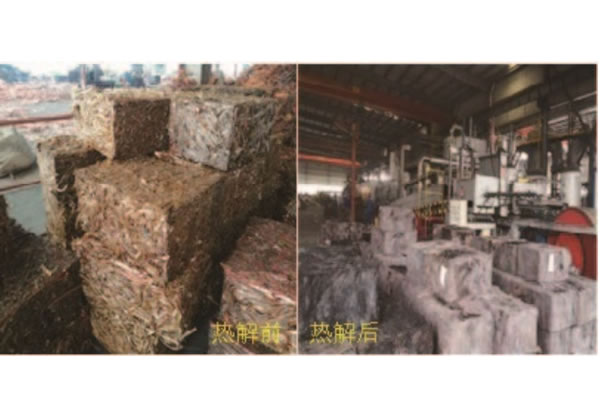
After monitoring, the average concentration of particulate matter is 10~15mg/m³, SO2 is not detected, the average of NOx is 100mg/m³, and all exhaust emission indicators are in line with national emission standards. FIG. 5 shows the comparison of waste enamelled wire before and after equipment treatment. After treatment, the enamelled wire paint is obviously carbonized, and a small part of the carbon attached can be removed by twisting the copper wire and wind separation.
Figure 5 Comparison of waste enamelled wire before and after treatment
4 Conclusion
Through years of scientific and technological research, Hunan Dingli Technology Co., Ltd. and Anhui Chujiang Technology New Material Co., LTD., together with other users, has successfully developed complete sets of technology and key equipment for continuous pyrolysis recovery of enamelled wire. The highest temperature can reach 900℃, the equipment can run continuously, the recovery rate of waste heat can reach more than 85%, and 99.5% of copper in enamelled wire can be recovered. The annual output of recycled copper has reached 33,000 tons, overcoming the technical obstacles of the intermittent waste enamelware recycling treatment, realizing the industrialization operation of waste enamelware recycling treatment with low energy consumption, low cost, high output and high quality, driving the application of thermal equipment in the field of solid waste recycling and environmental protection, and making outstanding contributions to the field of solid waste recycling and environmental protection.